Research

Solutions

About

Contact

Fields of research

Studying why strategies drift – and how AI can hold them steady.

At Paradox, we are researching the underlying mechanics behind this phenomenon: why most strategies drift, why shared understanding erodes at scale and why misalignment sets in. We investigate what it would take to continuously hold a living understanding of reality as it evolves – now with AI.

Research glossary:

Knowledge gap, strategy, execution, drift, context, Al, misalignment, cost of coordination

The knowledge gap

Most organizations inherently grow into complexity. As this happens they operate with a limited and fragmented understanding of themselves. What is true right now? What changed? What depends on what? What is actually constraining execution? The questions are many – and constant.

In Paradox, we are researching how this internal knowledge gap forms and why it persists – even in highly instrumented, data-rich environments. We study how documents, dashboards, search tools, and copilots often increase local productivity while leaving the collective understanding unresolved, only adding to the complexity.

Read publications

Drift, misalignment, and the cost of
coordination in complex environments

Drift, misalignment, and the cost of coordination in complex environments

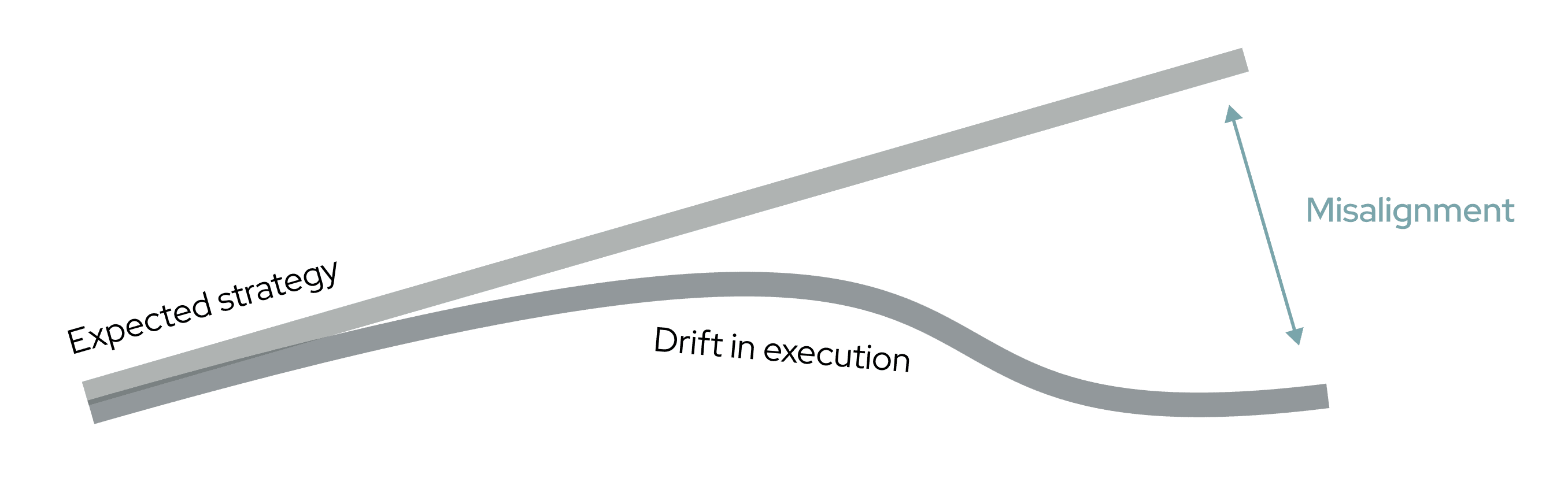
Strategy rarely fails because it is wrong. It fails because meaning changes as it travels through complex environments. When moving across layers, shifting priorities and diverging interpretations, alignment becomes an ongoing reconstruction effort.

We are researching drift as a structural phenomenon: how coordination scales, how shared understanding decays over time, and why alignment mechanisms (OKRs, reporting loops, sync meetings) often become a costly reactive maintenance activity rather than a proactive building block for momentum and growth.
Human-centered AI for organizational intelligence

We look at AI from a clear belief: technology should strengthen human capability — not sideline it.

In a landscape where AI is often framed as a replacement for thinking, we focus on how it can deepen it. Our work centers on how humans reason, collaborate, disagree, and build understanding together.

Intelligence is not only computational — it is relational. It emerges in conversation, in tension, in shared reflection. That is why the human perspective is foundational to our research and development.

We study how context shapes decisions, how misunderstandings arise, and how clarity is built collectively. AI’s role is to make complexity more visible — so humans can navigate it with greater awareness.

Natural inspiration for collective intelligence

In nature, large groups move coherently without centralized command. Alignment of execution emerges from shared signals and continuous adaptation.

We are researching natural systems not as metaphor, but as structural inspiration. What enables sustained coherence in dynamic environments?

How do systems remain adaptive without fragmenting?

What creates alignment without costly recreation of shared understanding?

Human-centered AI for organizational intelligence

We look at AI from a clear belief: technology should strengthen human capability — not sideline it.

In a landscape where AI is often framed as a replacement for thinking, we focus on how it can deepen it. Our work centers on how humans reason, collaborate, disagree, and build understanding together.

Intelligence is not only computational — it is relational. It emerges in conversation, in tension, in shared reflection. That is why the human perspective is foundational to our research and development.

We study how context shapes decisions, how misunderstandings arise, and how clarity is built collectively. AI’s role is to make complexity more visible — so humans can navigate it with greater awareness.

Natural inspiration for collective intelligence

In nature, large groups move coherently without centralized command. Alignment of execution emerges from shared signals and continuous adaptation.

We are researching natural systems not as metaphor, but as structural inspiration. What enables sustained coherence in dynamic environments?

How do systems remain adaptive without fragmenting?

What creates alignment without costly recreation of shared understanding?

Explore more of our thinking

On Substack we share deeper perspectives, research notes, and evolving ideas shaping Paradox.

Explore more of our thinking

On Substack we share deeper perspectives, research notes, and evolving ideas shaping Paradox.

© 2026 PARADOX A new order of organizational design.

Solutions

Apppa One

Xoda

Contact

info@apppa.ai


Sortedam Dossering 55 1,

2100 København Ø

Copenhagen

© 2026 PARADOX

A new order of organizational design.

Solutions

Apppa One

Xoda

Contact

info@apppa.ai


Sortedam Dossering 55 1,

2100 København Ø

Copenhagen

Researching organizational AI with humans at the center

We research AI from a clear belief: technology should strengthen human capability — not sideline it.

In a landscape where AI is often framed as a replacement for thinking, we focus on how it can deepen it. Our work centers on how humans reason, collaborate, disagree, and build understanding together.

Intelligence is not only computational — it is relational. It emerges in conversation, in tension, in shared reflection. That is why the human perspective is foundational to our research.

We study how context shapes decisions, how misunderstandings arise, and how clarity is built collectively. AI’s role is to make complexity more visible — so humans can navigate it with greater awareness.

Human-centered AI for organizational intelligence

We look at AI from a clear belief: technology should strengthen human capability — not sideline it.

In a landscape where AI is often framed as a replacement for thinking, we focus on how it can deepen it. Our work centers on how humans reason, collaborate, disagree, and build understanding together.

Intelligence is not only computational — it is relational. It emerges in conversation, in tension, in shared reflection. That is why the human perspective is foundational to our research.

We study how context shapes decisions, how misunderstandings arise, and how clarity is built collectively. AI’s role is to make complexity more visible — so humans can navigate it with greater awareness.